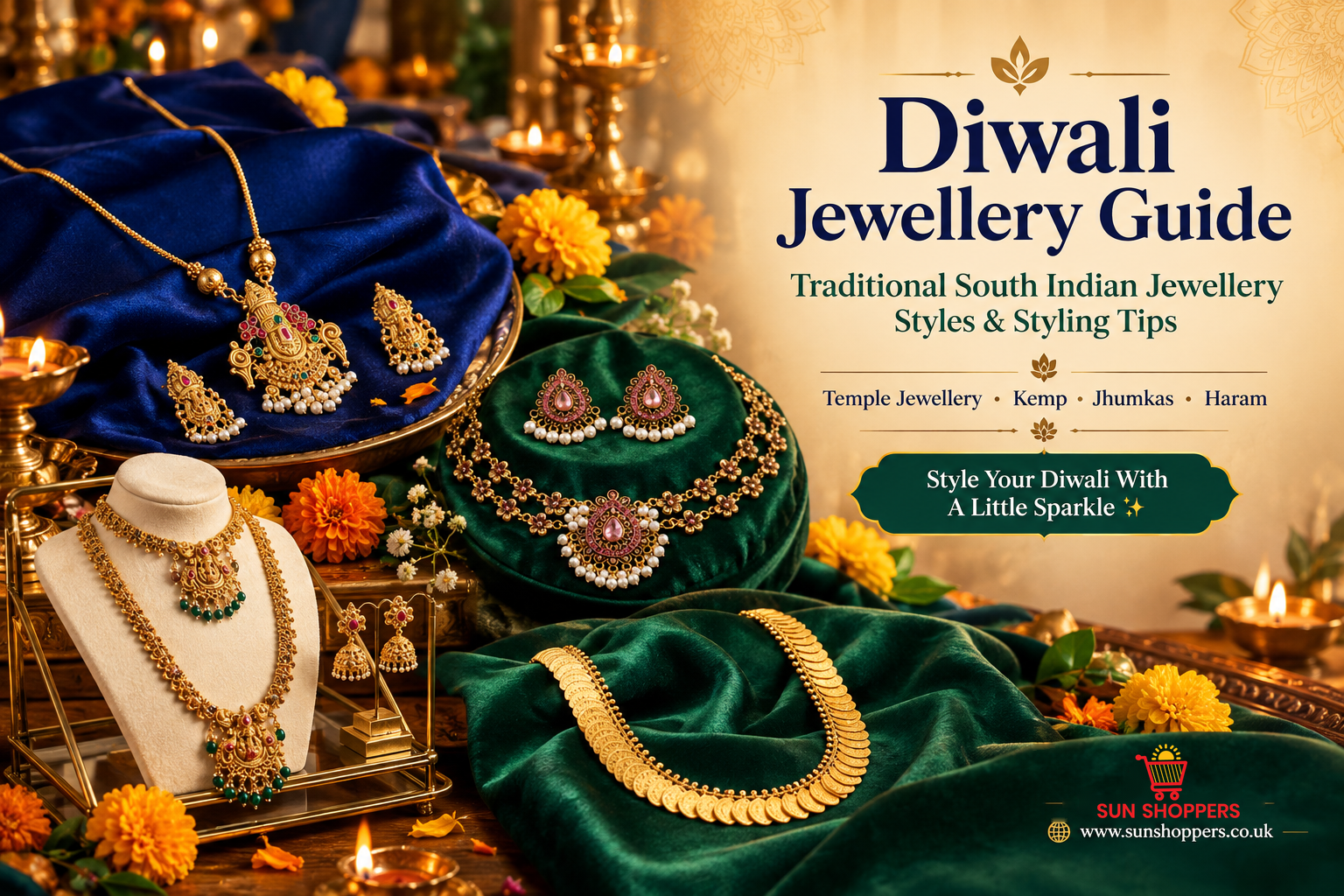
There’s a reason jewellery shops see some of their busiest days around Diwali. Buying gold or new jewellery on Dhanteras, the first day of the festival, is considered especially auspicious, believed to bring prosperity and good fortune into the year ahead. It’s a tradition that’s stayed strong for generations, whether it’s an investment piece in gold or a beautiful imitation set for festive dressing.
Whether you’re buying for yourself, choosing a gift for someone special, or simply want to understand the different styles of South Indian jewellery, this guide covers everything you need. We’ll walk through traditional jewellery types, from temple jewellery to kemp stones and jhumkas, how to style them for Diwali, the difference between gifting and buying for yourself, and how to properly care for your pieces so they stay beautiful for years to come.
Why Jewellery Matters at Diwali
Jewellery has always held a special place in Diwali celebrations, and it starts right at the beginning of the festival with Dhanteras. Traditionally, this is considered one of the most auspicious days of the year to buy gold, silver, or new jewellery, a practice believed to invite wealth, prosperity, and good fortune into the home for the year ahead. For many families, Dhanteras jewellery shopping is as much a part of the festival as lighting diyas or preparing sweets.
Beyond Dhanteras, jewellery plays a central role throughout Diwali as part of festive dressing, particularly for Lakshmi Puja on the main day. Traditional outfits are paired with jewellery to complete the look, earrings, bangles, and necklaces that reflect the richness and joy of the occasion.
Of course, not everyone wants to invest in gold, and that’s perfectly fine. Beautifully crafted imitation and artificial jewellery carries exactly the same festive spirit and tradition, without the cost that comes with precious metals. A well-made kemp or temple jewellery set can look every bit as stunning as gold, letting you dress up for Diwali, follow the tradition, and even change up your look each year without it costing a fortune.
Whatever your budget, jewellery remains one of the simplest and most meaningful ways to mark the occasion.
Types of Traditional South Indian Jewellery
If you’re new to South Indian jewellery, some of the terminology can feel unfamiliar. Here’s a straightforward guide to the key styles you’ll come across.
Temple Jewellery
Temple jewellery takes its name and inspiration from the ornate gold jewellery traditionally used to adorn deities in South Indian temples. It’s typically gold-toned, featuring intricate motifs, gods and goddesses, peacocks, lotus flowers, and other symbolic designs, crafted with detailed, almost sculptural precision. Originally worn by temple dancers and deities alike, temple jewellery has become a staple of South Indian bridal and festive wear, prized for its rich, regal look.
Kemp Jewellery
Kemp jewellery gets its name from “kemp stones”, uncut, polished coloured stones (traditionally glass or semi-precious material) most commonly seen in vivid red and green, though other colours appear too. These stones are set into gold-toned metal to create bold, richly coloured pieces. Kemp jewellery has a strong historical association with Bharatanatyam and other South Indian classical dance forms, where its vibrant colours and intricate settings catch the light beautifully under stage lighting, and it’s equally popular for bridal wear and festive occasions like Diwali.
Jhumkas
Jhumkas are a style of earring characterised by their bell or dome-shaped design, often with delicate danglers or pearl drops beneath. Originating from South Indian and broader Indian jewellery traditions, jhumkas have remained one of the most enduringly popular earring styles for their sheer versatility, subtle and delicate for everyday wear, or large, ornate, and statement-making for bridal and festive occasions. Their gentle movement as you move is part of their charm.
Haram (Long Necklace)
A haram is a long, often multi-layered necklace that sits lower on the chest, traditionally worn alongside a shorter necklace for a stacked, layered look. Harams are typically studded with kemp stones or crafted in temple jewellery style, and often feature a central pendant or motif as a focal point. While closely associated with South Indian bridal wear, harams are just as suited to Diwali and other festive occasions, instantly elevating a traditional outfit with their length and detail, a single haram can transform a simple saree or churidar into a complete festive look.
Together, these styles form the backbone of traditional South Indian jewellery, and understanding them makes it much easier to put together an authentic, well-coordinated look for Diwali.
How to Style Jewellery for Diwali
Once you know the different styles, putting together a festive look for Diwali comes down to balance, pairing the right pieces with your outfit and the occasion.
- Temple jewellery with silk sarees and traditional wear: Temple jewellery is a natural match for silk sarees, especially in rich colours like maroon, deep green, or gold, the intricate gold-toned detailing complements the texture and sheen of silk beautifully. A statement temple necklace paired with matching earrings is often all you need to complete a traditional Diwali look.
- Jhumkas for traditional and fusion outfits: Jhumkas are wonderfully versatile, smaller, delicate jhumkas work well with fusion outfits like a kurta or Indo-western dress, while larger, more ornate jhumkas suit traditional sarees and lehengas. If you’re mixing traditional and modern elements this Diwali, jhumkas are often the easiest way to bring in an authentic touch without overdoing it.
- Layering with a haram: For a more elevated, festive look, pair a shorter necklace with a haram for a stacked, layered effect, a classic South Indian styling technique that adds real depth and richness to an outfit. This works particularly well for bigger Diwali gatherings, where a more elaborate look feels appropriate.
- Simple vs. statement looks: How much jewellery you wear should really depend on the occasion. For a quieter, at-home Diwali celebration, simple jhumkas and a single necklace are often enough to feel festive without being overdone. For a larger Diwali party or gathering, layering a haram, temple jewellery set, and jhumkas together creates a fuller, more statement-making look that suits the occasion.
There’s no single “right” way to style South Indian jewellery, the key is choosing pieces that suit both your outfit and how big (or intimate) your Diwali celebration is.
Jewellery as Gifts vs. Jewellery for Yourself
Jewellery makes for a wonderful Diwali gift, but it helps to think about safe, versatile choices when buying for someone else. Smaller pieces, delicate jhumkas, a simple pendant, or a single well-made necklace, tend to be the safest bet, since they suit a wide range of outfits and personal styles without being too bold or specific to one look. These are the kinds of pieces someone can wear again and again, well beyond Diwali itself.
Buying for yourself is a different opportunity altogether. Diwali is the perfect excuse to invest in a statement piece, a full temple jewellery set, an elaborate haram, or a pair of bold kemp jhumkas you’ve been eyeing all year. Since Dhanteras and Diwali are traditionally associated with treating yourself to something special, this is very much the time to go for the piece you’ll get real joy from wearing, rather than something purely practical.
Whether you’re shopping for someone else or treating yourself, it helps to have a clear sense of what you’re looking for before you start browsing. Our Diwali Gift Guide has more ideas on choosing jewellery (and other gifts) for everyone on your list.
Caring for Imitation & Artificial Jewellery
Whether you’ve invested in a full temple jewellery set or picked up a few pieces for the season, a little care goes a long way in keeping imitation jewellery looking beautiful for years to come.
- Store pieces separately. Keep each item in its own soft pouch or lined box rather than piling pieces together in a drawer. This prevents stones from scratching against metal or other jewellery, which can dull the finish and loosen delicate settings over time.
- Keep it away from perfume, water, and sweat. Always apply perfume, hairspray, and lotions before putting your jewellery on, not after, these products can react with the plating and cause it to tarnish or discolour. Similarly, it’s best to remove jewellery before swimming, showering, or any activity likely to cause heavy sweating.
- Clean gently, and only when needed. A dry, soft cloth is usually all you need to keep pieces looking fresh, gently wipe away any dust or residue after wearing. If a piece needs a deeper clean, use a very slightly damp cloth rather than soaking it in water, and dry it immediately afterwards.
- Store away from sunlight and humidity. For long-term storage between festivals, keep jewellery in a cool, dry place out of direct sunlight, since prolonged heat and humidity can affect both the metal plating and the stones over time.
With just a little care, your festive jewellery can easily be brought out and enjoyed for many Diwalis to come.
Complete Your Diwali Look
From temple jewellery to kemp jhumkas and harams, South Indian jewellery brings a richness and tradition that’s hard to match, whether you’re dressing up for Lakshmi Puja or choosing a gift for someone special this year.
Browse our full jewellery collection to find your perfect piece this Diwali, and follow @sunshoppersjewels for more styling inspiration and new arrivals. For more Diwali ideas, take a look at our Diwali Gift Guide and complete Diwali UK Guide.
Wishing you a Diwali filled with light, joy, and a little sparkle. ✨
Shop the Jewellery Collection →