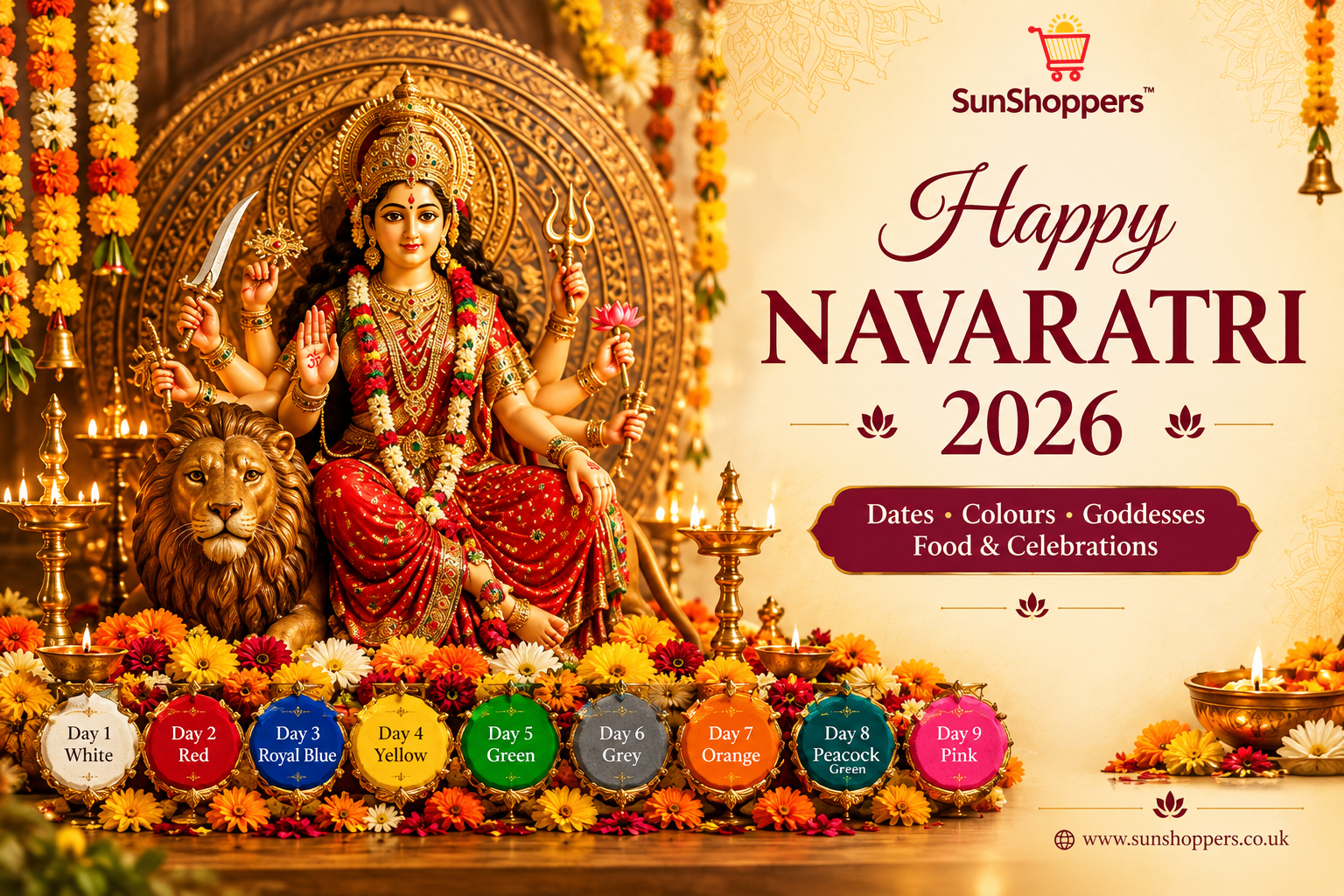
Navaratri, meaning “nine nights,” is one of the most widely celebrated festivals across India and, increasingly, across Indian communities in the UK too. In 2026, Navaratri begins around Sunday 11 or Monday 12 October, running for nine nights through to Dussehra on 20-21 October.
Each of the nine nights is dedicated to a different form of Goddess Durga, with its own colour, significance and rituals, and celebrations look quite different depending on where in India your family traditions come from, from Golu displays in the South to Garba nights in Gujarat and Durga Puja in Bengal.
In this guide, we’re covering everything: the nine days and their colours and goddesses, how Navaratri is celebrated across different regions, traditional food and fasting customs, and ideas for celebrating wherever you are in the UK.
What Is Navaratri?
Navaratri is a nine-night Hindu festival dedicated to the worship of Shakti, the divine feminine energy most commonly represented through Goddess Durga and her many forms. At its core, Navaratri celebrates the same theme found across most major Hindu festivals: the victory of good over evil.
The most widely known legend associated with Navaratri is that of Goddess Durga’s battle against the demon Mahishasura, whom she defeated after nine days and nights of fierce combat, a story that gives the festival both its name and its spiritual significance. In many parts of North India, this is also linked to Lord Rama, who is said to have worshipped Durga for nine days for strength before defeating Ravana on the tenth day, Dussehra.
While the underlying meaning is shared, how Navaratri is actually celebrated varies enormously depending on region and tradition. In Tamil Nadu and much of South India, it’s marked with Golu, elaborate doll displays set up in homes. In Gujarat and much of Western India, Navaratri is synonymous with Garba and Dandiya Raas, nights of dancing that draw huge crowds. In West Bengal, the festival takes the form of Durga Puja, with elaborate pandals and processions culminating in the immersion of Durga idols.
Wherever you’re from and however your family celebrates, Navaratri is ultimately a time of devotion, community, and celebration of the divine feminine.
The 9 Days of Navaratri: Colours & Goddesses
Each of the nine nights of Navaratri is dedicated to a different form of Goddess Durga, known collectively as the Navadurga. Alongside each day, many people also follow a specific colour to wear, a tradition that’s become especially popular in recent years.
A quick note before we get into it: colour sequences for Navaratri vary quite a bit depending on the source, region, and even the specific panchang (Hindu calendar) your family follows. There isn’t one single universally agreed list, so treat the colours below as a popular, commonly followed sequence rather than the definitive version. If your family or community follows a different order, that’s just as valid.
Day
Goddess
Colour
Significance
Day 1
Shailaputri
White
Purity and new beginnings
Day 2
Brahmacharini
Red
Strength, action, and devotion
Day 3
Chandraghanta
Royal Blue
Courage and grace
Day 4
Kushmanda
Yellow
Brightness, warmth, and positive energy
Day 5
Skandamata
Green
Growth, nature, and nurturing energy
Day 6
Katyayani
Grey
Balanced strength and transformation
Day 7
Kalaratri
Orange
Energy, fearlessness, and protection
Day 8
Mahagauri
Peacock Green
Compassion and calm
Day 9
Siddhidatri
Pink
Love, harmony, and fulfilment
Each goddess represents a different aspect of Durga’s power and character, from Shailaputri, the daughter of the mountains symbolising purity, through to Siddhidatri on the final day, representing the attainment of spiritual perfection. Many people wear the day’s designated colour, share it on social media, or coordinate outfits with family and friends as part of the celebration.
The 8th and 9th days also hold particular significance for many, with Kanya Pujan, the ritual worship of young girls as representations of the goddess, commonly observed during this period.
Whether you follow this exact sequence or a different one passed down through your own family, the spirit behind it remains the same: honouring the many forms of the divine feminine across the nine nights.
Regional Celebrations
Navaratri looks quite different depending on where in India your traditions come from, and all of these are equally valid ways of marking the festival.
Golu (South India)
In Tamil Nadu, Andhra Pradesh, Karnataka, and other parts of South India, Navaratri is marked with Golu (also called Kolu or Bommai Golu), an elaborate display of dolls and figurines arranged on a stepped stand, typically in odd numbers such as 5, 7, 9, or 11 steps. The display includes figures of gods and goddesses, mythological scenes, everyday life, and often family heirloom dolls passed down through generations.
Families invite friends, relatives and neighbours to visit their Golu, exchanging sundal (spiced legumes) and small gifts, and singing devotional songs together. Visiting multiple homes to see different Golu displays over the nine nights is a cherished part of the tradition, turning it into a genuinely communal celebration.
Garba & Dandiya (Gujarat & Western India)
In Gujarat and much of Western India, Navaratri is inseparable from Garba and Dandiya Raas, energetic circular dances performed over the nine nights, often late into the evening. Garba is traditionally performed with rhythmic hand claps, while Dandiya Raas uses decorated sticks, with dancers moving in coordinated patterns to the beat of dhol drums and live music.
Dressing up is a huge part of the occasion. Vibrant chaniya cholis, mirror-work fabrics, and traditional jewellery are worn for the nightly dance events, which have become major social occasions, with large public Garba nights now held across UK cities with significant Gujarati communities.
Durga Puja (Bengal & Eastern India)
In West Bengal and much of Eastern India, Navaratri takes the form of Durga Puja, one of the most significant festivals of the Bengali calendar. Elaborate, artistically decorated pandals (temporary structures) are built to house beautifully crafted idols of Goddess Durga, drawing large crowds for daily prayers, cultural performances, and community gatherings.
The festival culminates in Visarjan, the immersion of the Durga idol in a river or body of water, a moving and symbolic farewell marking the goddess’s return to her celestial abode, accompanied by processions, music, and collective emotion.
Navaratri Food & Fasting
Food plays a significant role in Navaratri, though the traditions around it vary. Some observe a strict fast throughout the nine days, while others focus on specific festive dishes without fasting at all.
Fasting Traditions
Many devotees observe Navratri vrat (fasting) for some or all of the nine days, following a satvik diet that avoids onion, garlic, regular grains, and non-vegetarian food. Instead, fasting meals typically rely on alternative flours and ingredients considered pure for the occasion.
Popular fasting foods include:
Sabudana khichdi — a dish made from tapioca pearls, peanuts, and mild spices
Kuttu atta (buckwheat flour) — used to make rotis or puris during the fasting period
Singhare ka atta (water chestnut flour) — another common fasting flour used for rotis and snacks
Fresh fruits — often eaten throughout the day to sustain energy
Milk and yoghurt-based dishes — including simple sweets like sabudana kheer or fruit-based lassis
Rock salt (sendha namak) is typically used in place of regular table salt during fasting days, as it’s considered more suitable for religious observance.
Regional Food Traditions
Beyond fasting, Navaratri also comes with its own regional food customs. In South India, sundal, a simple, spiced dish made from legumes like chickpeas, black-eyed peas or moong dal, is prepared fresh each day and shared with Golu visitors, with the specific legume often varying day to day.
In Bengal, Durga Puja is accompanied by bhog, a communal vegetarian feast offered to the goddess and then shared among devotees, often including khichuri (a rice and lentil dish), labra (mixed vegetables), and payesh (rice pudding).
Whether you’re fasting, cooking festive dishes, or simply stocking up on the right ingredients for the season, having the right pantry staples on hand makes Navaratri cooking far easier, from fasting flours and rock salt to spices and lentils for sundal and bhog. Browse our grocery range for everything you need this Navaratri.
Navaratri Activities
There’s plenty to get involved in over the nine nights, whether you’re following a specific regional tradition or simply want to mark the festival with family.
Set up a Golu display — If you follow the South Indian tradition, arranging your Golu steps is often a whole-family activity, bringing out dolls and figurines collected over the years and adding something new each season. It’s also a lovely opportunity to get children involved in learning about the stories behind each figure.
Attend Garba & Dandiya nights — Many UK cities with significant Gujarati communities host public Garba and Dandiya events throughout Navaratri, often organised by local temples, community halls, or cultural associations. These are welcoming, family-friendly events even if you don’t come from a Garba background, a great way to experience the tradition firsthand.
Observe Kanya Pujan — Typically performed on the eighth or ninth day, Kanya Pujan involves inviting young girls into the home, washing their feet, and honouring them with food and small gifts as living representations of the goddess.
Visit a local temple — Most UK cities with Hindu communities hold special Navaratri prayers, aartis, and cultural events at local temples throughout the nine nights. Checking your nearest temple’s events calendar is a good way to find out what’s happening locally.
Plan Dussehra gifting — As Navaratri draws to a close with Dussehra, exchanging gifts and sweets with family and friends is a common way to mark the festival’s end, a nice opportunity to plan ahead if you’re already thinking about gifting for the season.
Whatever traditions your family follows, Navaratri is ultimately about coming together, through food, dance, prayer, or simply spending time with the people you love.
A Joyful Navaratri to You and Your Family
However you celebrate, through Golu, Garba, Durga Puja, fasting, or simply spending time with loved ones, Navaratri is a time of devotion, colour, and togetherness. We hope this guide helps you feel ready for the nine nights ahead.
If you’re preparing for the festival, take a look at our jewellery collection for traditional pieces to complete your festive look, and our grocery range for fasting essentials and festive cooking ingredients.
Wishing you and your family a very happy and joyful Navaratri. 🙏